Posts

SCOTUS Free Speech Cases Lead to Informed Action through Service Learning

Image
by Mary Ellen Daneels, Civics Instructional Specialist The Illinois civics course requirements for both middle and high school require students to discuss current and societal issues to apply their knowledge of democratic institutions through civil discourse around essential questions facing our republic. A case taken up by the Supreme Court of the United States (SCOTUS) this term, Mahanoy v. B.L. is sure to animate many #CivicsInTheMiddle classrooms. This case involves a cheerleader removed from the squad for her Snapchat postings. This case will determine whether Tinker v. Des Moines Independent Community School District , which holds that public school officials may regulate speech that would materially and substantially disrupt the work and discipline of the school, applies to student speech that occurs off-campus. Chris Johnson, an Illinois Civics Instructional Coach from ROWVA Junior/Senior High School, led his students in an inquiry around the First Amendment that explored...

Civics and Environmentalism Intersect through Service Learning

Image
by Mary Ellen Daneels, Civics Instructional Specialist All educators are civics educators. This year’s Illinois Democracy Schools webinar series illustrated that civics happens across the curriculum. We send implicit and explicit messages to students about power, identity and justice through how we engage student voice in creating norms, the content we curate for classroom use and the way we engage both students and faculty in exploring the intersections of civic learning, school climate, and vision and leadership. Whether students aspire to be a dancer , scientist, accountant, farmer, or plumber, all occupations are impacted and impact public policy. All students are members of their community with lived experiences that make them uniquely qualified to be counted among “we the people.” All sectors of society contribute to making a “more perfect union.” Jason Artman, an Illinois Civics Instructional Coach , and his colleague Aaron Sester from Mendota High School had their social s...

What Role do I Play in Making “a More Perfect Union”?

Image
by Mary Ellen Daneels, Civics Instructional Specialist The mission statement of our constitutional republic can be found in the 52 words that comprise the Preamble to the U.S. Constitution . This ambitious opening statement by the framers challenges all of us to see ourselves as part of “we the people” and that we have a role to create that “more perfect union” in our communities. As Erwin Chemerinsky, Dean of Berkeley Law School; Jesse H. Choper Distinguished Professor of Law at the University of California - Berkley Law School and Michael Stokes Paulsen, Distinguished University Chair and Professor at University of St. Thomas School of Law, explain in the National Constitution Center’s Interactive Constitution : Importantly, the Preamble declares who is enacting this Constitution—the people of “the United States.” The document is the collective enactment of all U.S. citizens. The Constitution is “owned” (so to speak) by the people, not by the government or any branch thereof. We ...

Civics In Real Life

Image
by Mary Ellen Daneels, Civics Instructional Specialist The Illinois civics course requirements at both middle and high school require the use of current and societal issue discussions around essential questions facing our communities. Engaging students in these civic inquiries allow students to explore enduring issues that “we the people” have grappled with over the history of our constitutional republic and see themselves as having a role in making a “more perfect union.” The Lou Frey Institute (LFI) at the University of Central Florida recently joined the Illinois Civics Hub at the DuPage Regional Office of Education to connect educators with virtual resources that can be used to address current events from a civics lens. Civics in Real Life is a weekly series which uses civics concepts to explore timely topics in a one-page, student-friendly, image-rich text. This includes hyperlinks to related content and a closing activity that encourages reflection and engagement. The we...

The Underground Railroad Starts a Journey with Service Learning

Image
by Mary Ellen Daneels, Civics Instructional Specialist The Illinois Social Science standards provide a pathway for students to use rigorous historical inquiry to explore essential questions around justice to help students appreciate how individuals worked to create a “more perfect union” and their own rights and responsibilities in this constitutional republic. Students at Glenn Westlake Middle School in Lombard embarked on this journey to understand their own role as “we the people” with the help of social studies teacher Dana Bering and instructional coach Annette Hanson. Students studied the pre-Civil War era with attention to the Underground Railroad and how Harriet Tubman took action in the face of injustice. Then, students brought this topic of inequality and injustice into the present by engaging in a virtual Town Hall meeting with Illinois State Representative Terra Costa Howard to explore how she serves her constituents and the community resources they could use to be ups...

A User’s Guide to Democracy from Civics 101

Image
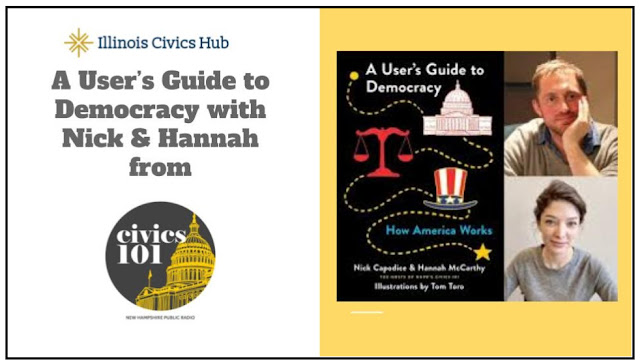
by Mary Ellen Daneels, Civics Instructional Specialist Recently, the Illinois Civics Hub hosted a book discussion with Nick Capodice and Hannah McCarthy , co hosts and executive producers for New Hampshire Public Radio’s Civics 101 Podcast . Nick and Hannah’s podcast is a “go to” resource for 6-12 civics classrooms for concise, easy to understand content on how our constitutional republic works.   A User’s Guide to Democracy: How America Works is Nick and Hannah’s answer to a beginner’s civics textbook, complete with witty and creative illustrations from Tom Toro that is sure to make complex topics like federalism and checks and balances come to life. Good Reads explains: Within this book are the keys to knowing what you’re talking about when you argue politics with the uncle you only see at Thanksgiving. It’s the book that sits on your desk for quick reference when the nightly news boggles your mind. This approachable and informative guide gives you the lowdown on everything fr...

Civics and the Arts

by Sue Khalaieff, Democracy Schools Network Manager Despite the unusual nature of the past school year, Democracy Schools have continued our mantra that “every teacher is a civics teacher.” To support this mission, we have offered a series of webinars since December that have explored “Civics across the Curriculum.” Blog posts and recordings are available on the Webinar Archive page. Melinda Wilson is the Dance Artistic Director at Curie Metropolitan High School for the Performing and Visual Arts in Chicago. She is a choreographer, dance instructor, dancer, and test writer for ISBE dance certification. Melinda has been recognized for her work — both locally and globally — with great distinction and numerous awards. She has vigorously engaged her students in meaningful ways in their communities. Melinda’s leadership in connecting the arts and civics makes her a valuable member of the Advisory Council of the Democracy Schools Network. How do the arts help students find their voi...